
Research News
The Philosophical Undertone of Eastern Aromatherapy: Decoding "Using Qi to Function" in TCM
Fragrance is not just an olfactory delight but an "invisible medicine" that travels through meridians. Explore the ancient wisdom and modern scientific echoes behind the TCM aromatic theory of "Using Qi (Fragrance) to Function".

When "Aromatherapy" is mentioned, many people immediately picture essential oil massages and SPAs originating from the West. However, if you open the voluminous ancient Chinese medical texts, you will be surprised to find that the Chinese wisdom of using "fragrance" to treat and prevent diseases has spanned thousands of years.
In the grand theoretical system of Traditional Chinese Medicine (TCM), aromatic herbs have a highly Oriental philosophical label: "Using Qi (Fragrance) to Function." The "Qi" here is not merely a simple gas as defined by modern physics; rather, it refers to the unique "scent" of aromatic substances and the "energy flow" they stimulate within the human body.
The ancients believed that aromatic TCM could cure diseases precisely because their "fragrance" possessed unique penetrability and agility. As the Ming Dynasty medical expert Jia Suoxue stated in *Yao Pin Hua Yi* (Transformation and Meaning of Medicines): "Fragrance can clear Qi, mainly disperse, awaken the spleen Yin, and penetrate the heart Qi." This means that "fragrance" is not just a physical property perceived through smell, but also a medicinal property that can directly participate in the human body's physiological regulation.
When we smell the aroma of Patchouli or Eupatorium, this "Qi" can awaken a spleen and stomach bogged down by dampness; when we smell Musk or Borneol, this extremely sharp "fragrance" can even instantly penetrate the blood-brain barrier and wake a person from a coma (which TCM calls "opening the orifices"). From this perspective, fragrance is no longer a pure olfactory enjoyment but transforms into an "invisible medicine" that can travel through meridians and internal organs, dispel evil Qi, and harmonize Qi and blood.
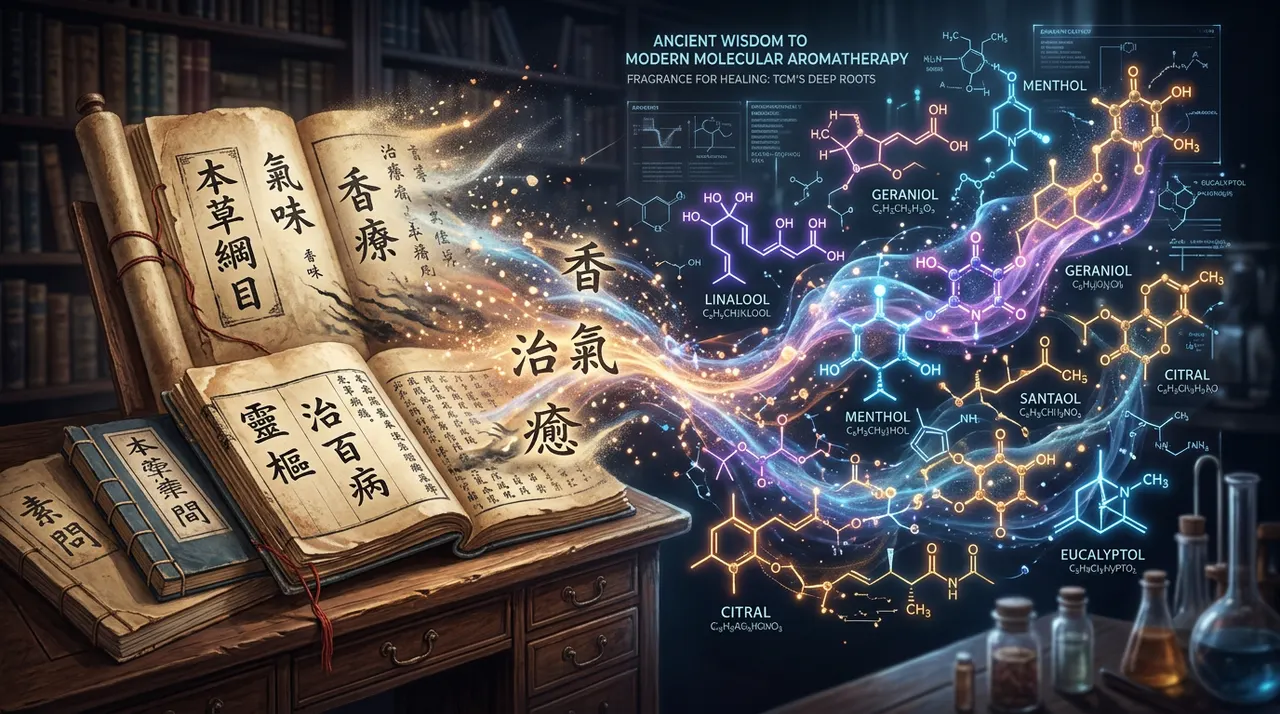
The microscope of modern science is gradually deciphering the molecular codes behind "Using Qi to Function." Studies have found that these substances called "fragrance" by the ancients are actually highly complex volatile organic compounds (i.e., plant essential oils). With extremely small molecular weights and lipophilicity, they can not only directly affect the brain's limbic system (regulating emotions and endocrine) via olfactory nerves but also quickly enter the blood circulation through the lungs and skin.
Translated into modern terms, "Using Qi to Function" means "utilizing highly volatile, highly penetrating small-molecule natural active compounds for multi-target intervention." This seemingly mystical Eastern wisdom coincidentally aligns with the modern medical concepts of "non-invasive therapy" and "treating body and mind together."
In today's globalized aromatherapy industry, revisiting the TCM concept of "Using Qi to Function" is not only a tribute to traditional culture but also injects a profound theoretical soul into the development of modern aromatherapy. Fragrance, the most ethereal breath of nature, is taking flight on the wings of TCM wisdom, revealing endless possibilities in the modern health sector.
Reference PDF for study; cite the published version.
> Reference: > ZHAO Hai-ping, KANG Lin-zhi, LUO Yun, et al. Exploration of "Using Qi (Fragrance) to Function" in Aromatic Chinese Medicine[J]. Journal of Traditional Chinese Medicine, 2021, 62(9): 818-821.