
Research News
Breaking the "Superbug" Dilemma: The Green Antibacterial Battle of Plant Essential Oils
With the emergence of "superbugs", the human battle against pathogens faces severe challenges. Plant essential oils provide a highly promising natural green solution with their multi-target, comprehensive synergistic approach.

Since the discovery of antibiotics, humanity seemed to have gained the upper hand in the battle against pathogenic bacteria. However, with the global overuse of chemical antibiotics, this silent war is quietly reversing. Bacteria that were once vulnerable have continuously evolved and mutated under the repeated "tempering" of antibiotics, eventually donning impenetrable armor and becoming the much-feared "superbugs."
As we face the potential crisis of being "incurable," scientists' gazes have unanimously turned to nature—to plant communities that have undergone billions of years of natural selection and co-evolution with pathogens. Hidden within plants is a natural defense weapon: volatile oils (plant essential oils).

The antibacterial strategy of plant essential oils is fundamentally different from that of single-target chemical antibiotics. Antibiotics are often like a precision-guided sniper rifle, aiming only at a specific fatal weakness of the bacteria. While fast-acting, this allows bacteria to easily figure out the routine and develop resistance. Plant essential oils, on the other hand, are more like a well-equipped, coordinated combat force.
Essential oils contain hundreds or thousands of complex chemical components, such as terpenes, alcohols, and phenols. Working in synergy, they launch a multi-dimensional attack on pathogens. Some components are responsible for destroying the bacterial cell wall, stripping away its protective barrier; others penetrate the cell to interfere with the bacteria's energy metabolism and protein synthesis; still others can inhibit the formation of "biofilms"—the ultimate shield that allows bacteria to cluster together and resist drugs. It is precisely this multi-target, comprehensive attack method that makes it difficult for bacteria to withstand and even harder to develop resistance.
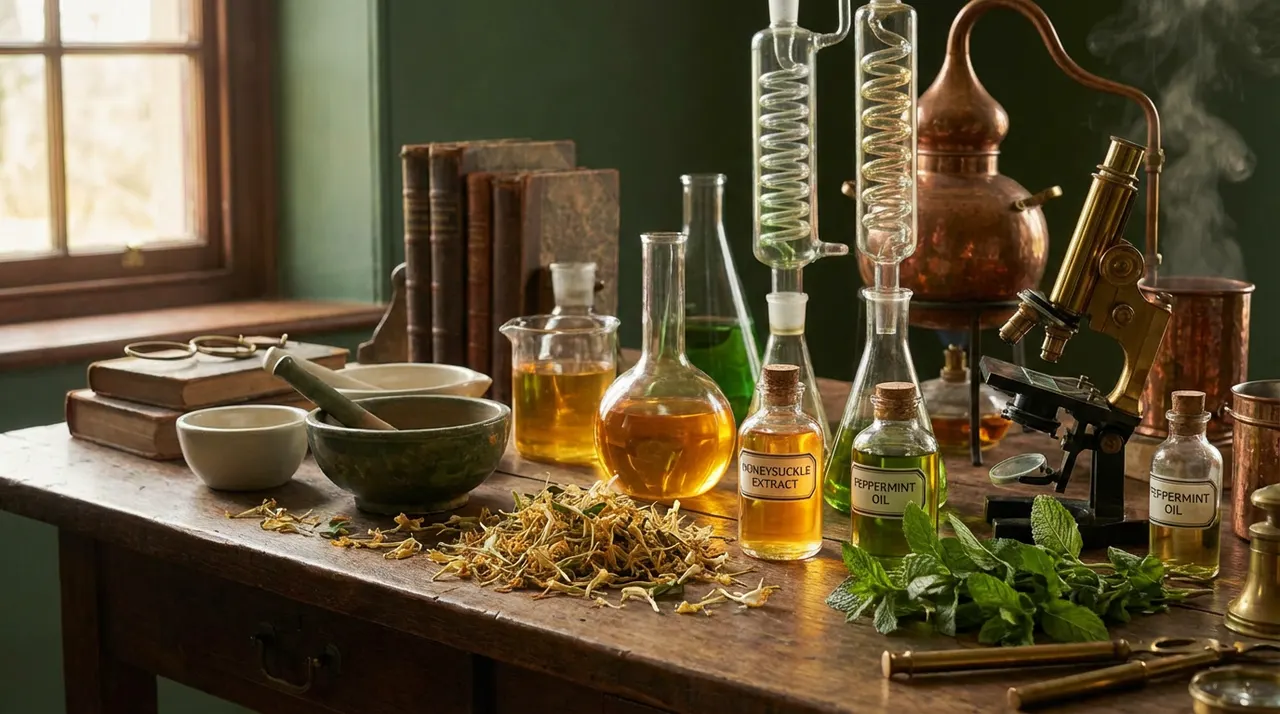
In ancient Eastern herbal wisdom, aromatic traditional Chinese medicines such as mugwort, clove, and patchouli have been used since antiquity to "ward off evil and prevent epidemics." Under the microscope of modern science, these experiences are radiating new vitality. Studies have found that cleverly combining different herbal volatile oils often produces a "1+1>2" synergistic effect. They can not only significantly reduce the pathogens' resistance to a single drug but also reduce the dosage used, thereby lowering toxic side effects.
Even more ingeniously, plant essential oils not only directly kill pathogens but also awaken the body's own immune defenses. Certain essential oil molecules can regulate the body's inflammatory response and enhance the phagocytic ability of macrophages, fundamentally improving the body's ability to ward off foreign invaders. This perfectly aligns with the TCM concept of disease prevention: "When healthy Qi is stored within, pathogenic evils cannot interfere."
In the face of the increasingly severe antimicrobial resistance crisis, plant essential oils offer a highly promising "green" solution. Not only are they widely sourced and environmentally friendly, but more importantly, they break the deadlock of traditional antibiotics' "kill a thousand enemies, lose eight hundred allies" approach. In a manner more in tune with natural laws, gentler, and more sustainable, they safeguard our health and lives. In this era desperate for a breakthrough, the ancient aroma of nature is transforming into the sharpest sword of modern technology.
Reference PDF for study; cite the published version.
> Reference: > WANG Liang-feng, LI Hui-ting, CHEN Qing-yao, et al. Research progress on antibacterial activity of herbal volatile oil[J]. China Journal of Chinese Materia Medica, 2021, 46(5): 1060-1066.