
popular-science
Southern Oranges and Northern Trifoliate Oranges? Uncovering the Huge Differences in "Vitex Trifolia" Volatile Oil Across Origins
Are Vitex trifolia from Guangxi and Jiangxi equally effective? GC-MS analysis reveals a cruel truth: depending on the origin, the components and contents of the heat-clearing essential oils differ drastically!

Vitex trifolia (Manjingzi) is a small fruit produced by an aromatic plant growing on sandy beaches or riverbanks. In TCM, it is a famous medicine for "dispersing wind-heat and clearing the head and eyes," often used to treat cold headaches and red, swollen eyes. Its main weapon is the rich volatile oil in the fruit.
However, the ancients often said, "Oranges grown south of the Huai River are oranges; grown north, they are trifoliate oranges." TCM has extremely strict requirements for "Daodi" herbs (authentic herbs from specific regions). Currently, the Vitex trifolia sold on the market comes from all over the country. Is the quality of volatile oil in them really all the same?
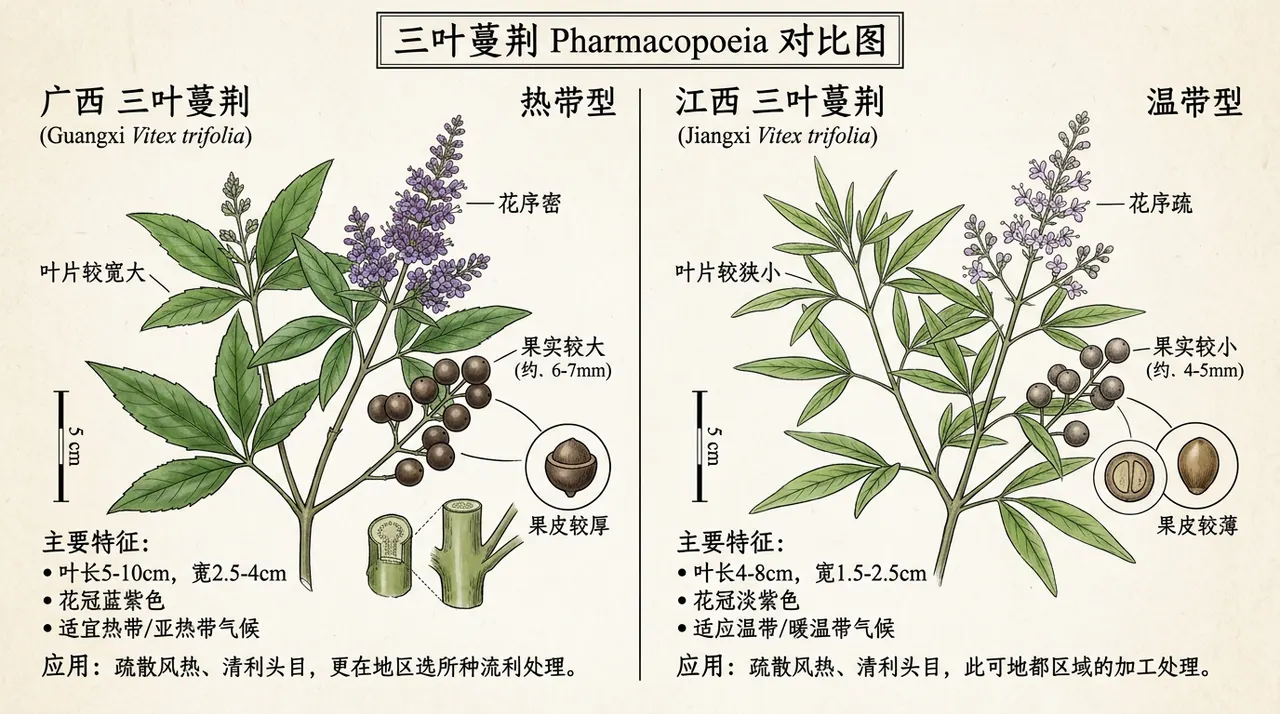
Guangxi vs. Jiangxi: The Great Volatile Oil Showdown
To uncover the truth, researchers purchased Vitex trifolia from two different origins on the market, Yulin, Guangxi and Jiangxi. They extracted their essential oils using the same hydrodistillation method and sent them to GC-MS for a molecular-level duel.
The first round compared "oil content and physical properties": the oil yields of the two origins were similar, but there was a significant deviation in optical rotation (an indicator reflecting the spatial structure of molecules).
The second round's "component perspective" revealed an extremely cruel difference: In the sample from Yulin, Guangxi, 32 compounds were identified; In the sample from Jiangxi, 28 compounds were identified. Shockingly, between these two seemingly identical plants, there were only 13 shared identical components in their volatile oils! This means that more than half of the chemical substances inside them are different.
The Disparity of Core Therapeutic Components
Among the shared components, the gap in content is even more jaw-dropping.
One of the most core active ingredients in Vitex trifolia is Eucalyptol (1,8-Cineole), which has extremely strong antibacterial, anti-inflammatory, and transdermal promoting effects. GC-MS data showed that in the essential oil from Guangxi, the eucalyptol content was as high as 33.35%, occupying absolute dominance; however, in the essential oil from Jiangxi, its content was astonishingly low at only 1.71%! The essential oil from Jiangxi was instead dominated by massive amounts of α-pinene (30.12%).

Re-emphasizing "Daodi Herbs"
This comparative study extremely vividly proves the huge impact of environment, climate, and soil on plant secondary metabolites (volatile oils).
It warns modern TCM practitioners and pharmaceutical enterprises: when procuring herbs, you absolutely cannot just look at the plant's name. The difference in origin leads to huge variations in chemical components, which directly affects the final clinical efficacy. Only by establishing strict quality evaluation standards for origins through such precise analytical instruments can we ensure that the TCM consumed by ordinary people exerts its proper miraculous effects every time.
Reference PDF for study; cite the published version.