
popular-science
The Art of Kumquat Essential Oil Extraction: "Boiling" or "Steaming"?
When extracting precious essential oil from kumquat peels, the process determines the quality. Scientists compared "co-boiling with water" and "pure steam distillation", finding pure steam brings higher yields and purer aromas.

The Kumquat (Fortunella crassifolia) is not only an ornamental potted plant signifying good luck during the New Year, but its golden peel also hides a delightful citrus fragrance. Kumquat volatile oil (essential oil) is rich in D-limonene, possessing extremely high application value in perfumes, food, and even antibacterial drugs.
The most traditional method for extracting this essential oil is hydrodistillation. However, in specific operations, it divides into two schools: one is boiling the kumquats directly in water (co-boiling distillation), and the other is placing the kumquats above the water, relying purely on hot steam (pure steam distillation). Do these two seemingly similar methods extract the same essential oil?
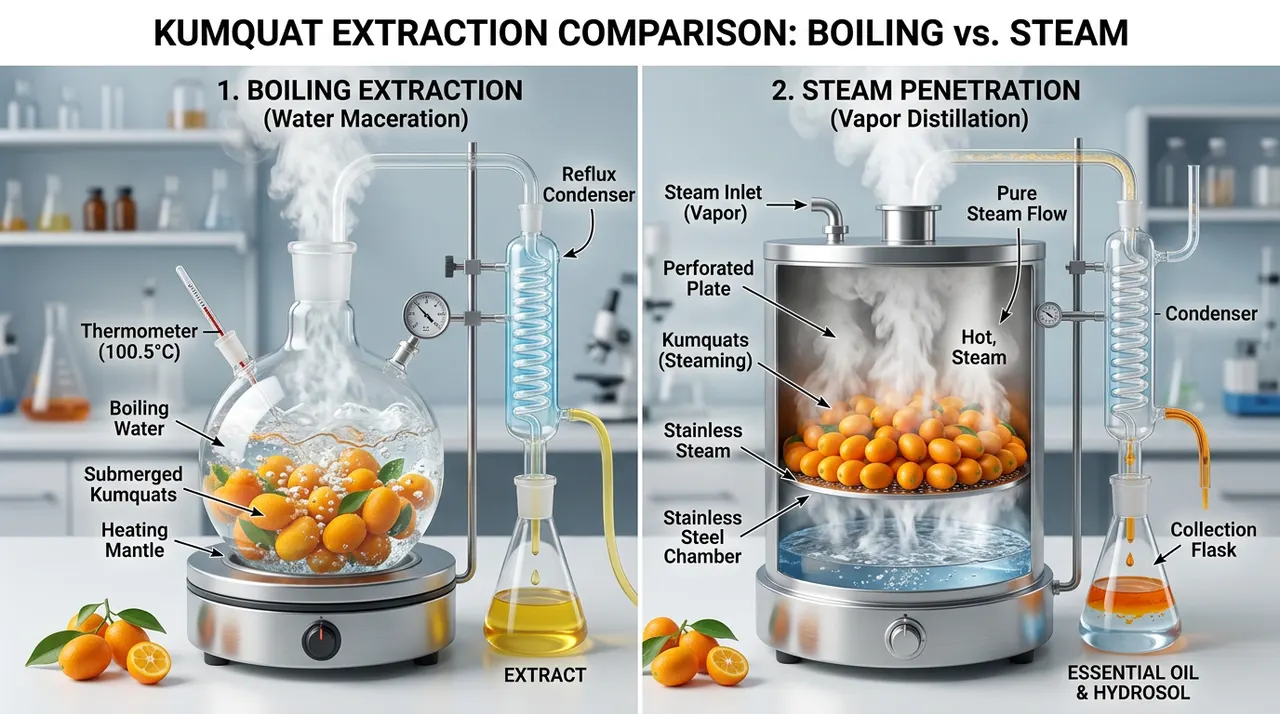
The Duel of Yield and Purity
To resolve this doubt, researchers extracted the volatile oil of kumquats using these two methods separately and conducted a microscopic component "grand parade" using Gas Chromatography-Mass Spectrometry (GC-MS) technology.
The experimental results gave a clear judgment of superiority: Pure steam distillation won completely. - Visible Yield: The essential oil yield of the pure steam method was 0.89%, significantly higher than the 0.61% of the co-boiling method. - Components are "Fewer but Purer": The co-boiling method extracted 72 peaks (identifying 50 components, with more impurities), while the pure steam method only separated 40 peaks (identifying 33 core components).
Why is "Steaming" Better Than "Boiling"?
GC-MS data revealed the scientific principles behind this. The backbone of kumquat essential oil is D-limonene (a molecule with a clear, sweet citrus scent). In the essential oil extracted by pure steam, the proportion of D-limonene was as high as 85.34%, compared to only 72.82% in the co-boiling method.
When plant materials are directly soaked in boiling water (co-boiling), the prolonged high-temperature boiling not only easily causes some heat-sensitive aroma molecules to decompose or deteriorate (producing a so-called "boiled" or "burnt" smell) but also dissolves some unwanted polar macromolecules, resulting in "many and messy" essential oil components. In contrast, pure steam extraction is like a precise "micro-airflow sweep"; it only takes away the most active, quintessential aromatic oil molecules, preserving the purest fruity scent of the kumquat.

The Golden Rule Guiding Industrial Production
This research not only provides clear process guidance for the spice industry but also demonstrates the finesse required in extracting active ingredients from medicinal herbs. If your goal is to obtain citrus essential oil with high yield and pure aroma, "pure steam extraction" is absolutely the uncompromising golden rule.
Reference PDF for study; cite the published version.