
popular-science
The Magic of Ginger Juice: How Fresh and Dried Ginger "Reshape" the Efficacy of Magnolia officinalis?
TCM often mentions "ginger-processed Magnolia officinalis", but did you know fresh and dried ginger cause completely different chemical reactions during processing? GC-MS analysis reveals the profound effects of these two excipients on its volatile oil.

Magnolia officinalis (Houpo) is a potent herb used in TCM for "directing Qi downward, removing distention, drying dampness, and resolving phlegm." To mitigate its irritation to the throat and gastrointestinal tract, ancient physicians invented the processing method of "ginger-processing"—soaking and roasting it with ginger juice.
However, ginger in TCM is divided into "fresh ginger" (dispelling cold and relieving the exterior) and "dried ginger" (warming the middle and restoring Yang). When processing Magnolia officinalis, are these two brothers merely different in their degree of warmth? What magic do they perform at the microscopic chemical level?
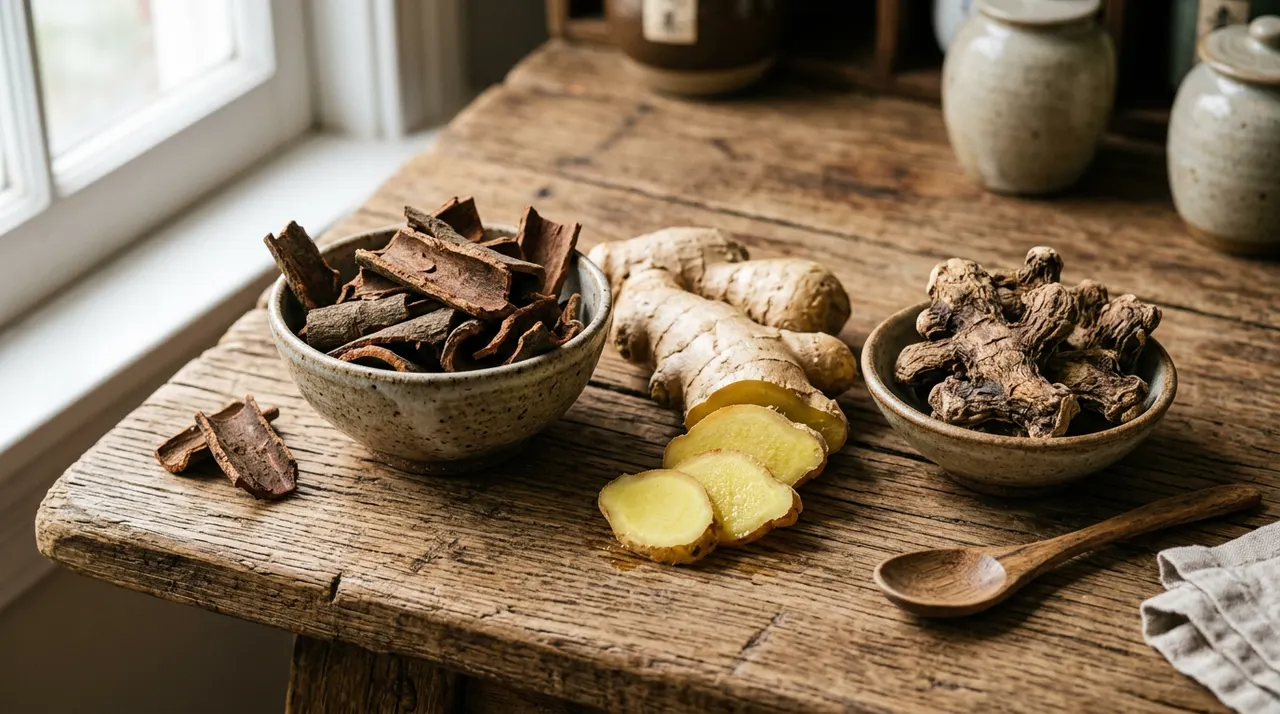
The Battle of Gingers: Oil Yield Comparison
Scientists utilized Gas Chromatography-Mass Spectrometry (GC-MS) technology to comprehensively measure the volatile oils of raw Magnolia, fresh ginger-processed Magnolia, and dried ginger-processed Magnolia.
Firstly, the ingredients of the excipients themselves differ vastly: 9 compounds were detected in fresh ginger, compared to a staggering 38 in dried ginger. After using them to process Magnolia separately, the total amount of volatile oil in dried ginger-processed Magnolia was slightly higher than that of the fresh ginger-processed one. This implies that the deep spicy flavor of dried ginger injects richer lipid-soluble substances into Magnolia.
Precise Fine-tuning of Efficacy Components
Even more fascinating is the "reshuffling" of volatile oil components. The study found that raw Magnolia contains 16 volatile components. After processing, although the total number didn't change drastically (16 for fresh ginger, 17 for dried ginger), their relative proportions tilted exquisitely.
Among the 14 shared components between the two processed forms, 4 were higher in the fresh ginger-processed Magnolia, while the rest were dominant in the dried ginger-processed one. This seemingly minor concentration shift is exactly the material basis for TCM clinical choices of different ginger juices. If you need Magnolia to lean towards "moving Qi, resolving stagnation, and expelling exterior pathogens," the lively components of fresh ginger might be superior; but if the goal is to "warm the middle, resolve dampness, and directly target the spleen and stomach," the profound lipid substances of dried ginger can better synergize with Magnolia.

Unveiling the Mystery of Excipient Processing
This research not only provides modern scientific data support for "ginger-processed Magnolia" but also demonstrates the profoundness of TCM processing science. Different excipients don't just reduce toxicity and side effects; they act like "chemical regulators," precisely guiding the medicinal direction of TCM through penetration and replacement at the molecular level.
Reference PDF for study; cite the published version.