
cultural
Eastern Philosophy in Curling Smoke: The Loss and Revival of Chinese Incense Culture
The history of incense in China goes back a long way. It was not only one of the four elegant activities of scholars, but also an important branch of TCM aromatherapy. This article deeply interprets Chinese incense culture.

In modern fast-paced urban life, people are accustomed to masking fatigue with strong perfumes and Western chemical essential oils. However, in neighboring Japan, the "Way of Incense," revered as a national essence, often gives visiting Chinese a piercing sense of unfamiliarity. Facing this elegant art that originated in China and flourished in the Tang and Song dynasties, we cannot help but ask: Where did the delicate fragrance that permeated Chinese scholars for thousands of years go?
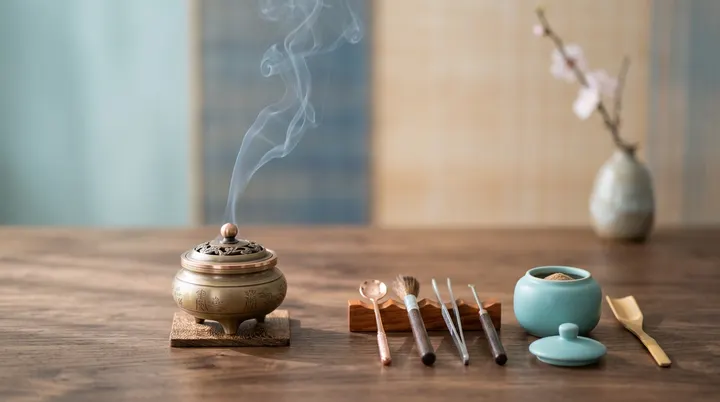
From Ancient Sacrifices to Scholars' Desks: The Historical Evolution of Incense
The history of incense use in China resonates with Chinese civilization itself. It began with ancient sacrifices to heaven and earth, sprouted in the pre-Qin period, and by the Han, Wei, and Six Dynasties, with the appearance of the Boshan incense burner, incense culture became widely popular. By the Sui and Tang dynasties, social and economic prosperity made incense use a common trend among the upper class; and entering the Song and Yuan dynasties, the literati class's ultimate pursuit of spiritual life elevated "smelling incense" to be alongside "tasting tea, arranging flowers, and hanging paintings" as the "four leisurely activities," establishing strict rituals and formally pushing incense appreciation to the level of the "Way" (Dao).
Unfortunately, by the late Qing Dynasty, accompanied by internal and external troubles and the influx of Western culture, this pure art form that had been passed down for thousands of years gradually declined, ultimately almost turning to cold ashes amidst the storms of war. Today, most Chinese people's understanding of "incense" is limited to the smoky "incense offering" rituals in Buddhist temples, having long forgotten the profound heritage it once contained as a philosophy of life.
Agarwood, Sandalwood, Ambergris, and Musk: Not Just Fragrance, But Medicine
As the ancient saying goes: "Agarwood, Sandalwood, Ambergris, and Musk." Among these four famous incenses, agarwood (Chenxiang) is particularly preeminent. Many people don't know that the formation of agarwood requires the tree to undergo trauma such as lightning strikes or insect bites, healing and scabbing under specific temperature and environmental conditions. The process is extremely demanding, hence its extraordinary preciousness.
In Chinese culture, incense has never been just a scent; it is a profound medical system. A major contribution to the development of traditional Chinese medicine in the Song Dynasty was "aromatic regulation of Qi"—treating illnesses and making medicine with incense. Natural agarwood is pungent and warm in nature, entering the kidney, spleen, and lung meridians. It can clear the meridians, dispel evil toxins, and calm the mind. Whether it's a prominent Buddhist monk gathering his spirit before ancient scrolls, or ancient physicians using yellow ripe agarwood in decoctions and medicine, they had long perceived the magical effects of fragrance on regulating human Qi, blood, and mental states.
Pen, Ink, and Fragrance: The Soul Mate of Literati
Studying Chinese culture without "incense" is destined to be incomplete. From the Wei and Jin to the Tang and Song dynasties, incense permeated almost every crevice of literati life: clothes needed incense to be fragrant, quilts needed incense for warmth; when tuning strings and playing the lute, a stick of clear incense could guide the rhythm; when tasting tea and discussing the Dao, there could be no gathering without incense.
Su Shi once wrote the enlightenment of "a stick of smoke dissipates, the fire turns cold, half a lifetime passes, the body ages, but the heart is at leisure"; Chen Qufei chanted the broad-mindedness of "worldly affairs have past and present, but the nature of incense remains unchanged" in "Burning Incense"; Li Qingzhao left the eternal masterpiece "Thin mist and thick clouds grieve the eternal day, Ruinao (dragon brain incense) melts in the golden beast burner." The Ming Dynasty talent Tu Long highly evaluated the wonderful uses of incense: whether reading at night to ward off sleep, adding romance, or tasting tea in the afternoon, incense can adapt to the occasion, clearing the mind and pleasing the spirit. It can be said that the fragrance of thousands of years, like silent spring rain, has silently nourished and shaped the detached and refined character base of Chinese scholars.
Reshaping Modern People's "Fragrant Life"
In this era of multiplying pressure, our bodies can sweat profusely in the gym, but where should our souls go to find a resting place?
Ancient incense culture is not an obsolete relic that is too highbrow to be popular; it can perfectly blend into modern life. Waking up in the morning, light a refreshing incense to quickly restore the brain's clarity; when working at a desk, burn a coil of mellow agarwood to calm anxious emotions; during the long night, place a calming incense by the bedside to enter deep sleep accompanied by the faint fragrance.
From a petal of heartfelt incense to the modern aromatherapy system, this is a cultural calling across millennia. Rediscovering the Way of Incense is not only to retrieve that lost Eastern classical beauty but also to provide modern people with an elegant lifestyle that combines wellness and sentiment, science and art. It's time to let this charming fragrance that has wafted for thousands of years linger in our lives once again.