
popular-science
Locking Essential Oils in "Stone": How Mesoporous Silica Solidifies Citrus Reticulata Volatile Oil?
Chenpi essential oil is highly volatile and hard to make into pills. Scientists found a "sponge stone" full of tiny holes—mesoporous silica—successfully turning liquid oil into highly stable solid powder.

Citrus reticulata (Chenpi), a national classic TCM herb for "regulating Qi, strengthening the spleen, drying dampness, and resolving phlegm," has its core therapeutic substance in its fragrant volatile oil (rich in D-limonene).
In modern manufacturing, if you want to make Chenpi into convenient capsules or pills, you encounter a big problem: volatile oil is liquid and extremely prone to evaporating and drying out in the air. How to turn an active liquid into a stable solid? Pharmaceutical engineers brought in a nano-scale "oil-locking expert"—Mesoporous Silica (350FCP).

The Super Sponge: Bottomless Adsorption Power
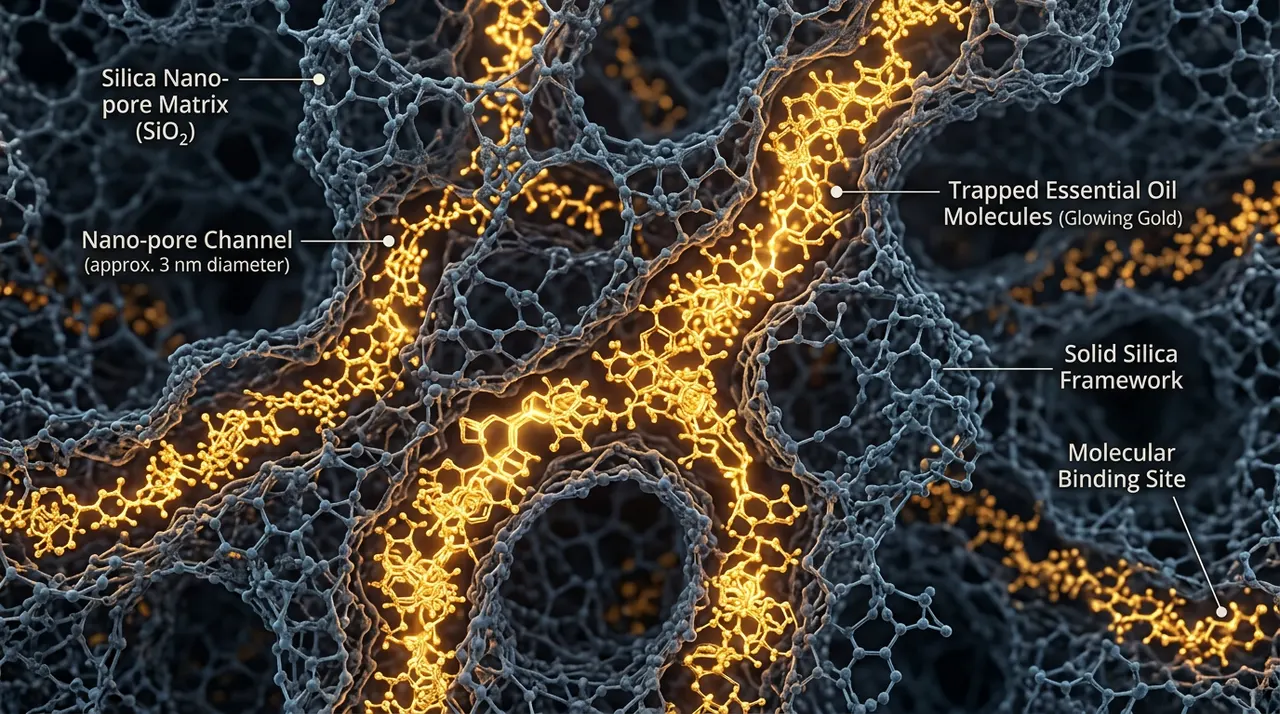
Silica, plainly speaking, is the main component of sand and quartz. But under nanotechnology, it is made into a powder whose interior is full of countless extremely tiny holes (mesopores). It acts like a hardcore super sponge with an astonishingly large surface area (the internal surface area of one gram of powder could cover several basketball courts!).
Researchers dropped liquid Chenpi volatile oil into this mesoporous silica powder to mix. A wonderful thing happened: driven by powerful capillary forces, the essential oil was "sucked" deep into those extremely tiny pores. Even when mixed at an extreme ratio of Oil : Excipient = 3 : 1 (three times more oil than powder), the result was still a dry-looking, highly flowable solid powder! This is the "solidification" technology in pharmaceutics.
Locking Time, A Dimensional Strike Against Volatilization
How effective is locking essential oil in stone pores? Scientists conducted rigorous volatilization curve tests.
Under constant 60°C baking, without protection, pure Chenpi essential oil is like water spilled on a hot pan, frantically evaporating over 50% in the first 4 hours. But for the essential oil powder solidified by mesoporous silica (350FCP), the volatilization rate presented an extremely gentle straight line. Even after 12 hours of baking, the volatilization rate was only a tiny fraction!
Gas Chromatography-Mass Spectrometry (GC-MS) analysis found that those low-boiling-point components extremely prone to escaping (like α-pinene, β-myrcene) were deeply locked inside the mesopores, greatly extending their lifespan.
The Pharmaceutical Leap from Liquid to Powder
This research provides a textbook paradigm for solid preparations of TCM volatile oils.
Utilizing the super adsorption power and spatial steric hindrance effect of mesoporous silica not only perfectly solves the process difficulty of making essential oils into solid pills (tablets, capsules) but also greatly enhances the stability of the herbs during storage and transport. This allows traditional aromatic TCM to take an extremely solid step on the path of modern industrialization.
Reference PDF for study; cite the published version.