
Science
"Those Days of the Month": How Aromatic Essential Oils Gently Untangle the Body's "Pain Knots"
Primary dysmenorrhea is not just physical pain, but a micro-storm of body and mind. Beyond painkillers and endurance, TCM aromatherapy offers a gentle and profound way to soothe.

For many women, there are those few days every month when the body feels tightly gripped by an invisible hand. The heavy, aching lower abdomen, cold sweats, and even radiating lower back pain... Primary dysmenorrhea, often dismissed as a routine chore to "just endure," is actually a localized micro-storm within the body.
Modern medicine has found that this is often related to abnormal spikes in prostaglandin levels in the endometrium. In the eyes of Traditional Chinese Medicine (TCM), this restriction—where "lack of flow causes pain"—is typically due to stagnation of Qi and blood, or cold coagulating the meridians. Faced with this cyclical torment, beyond popping painkillers or simply toughing it out, is there a gentler solution?
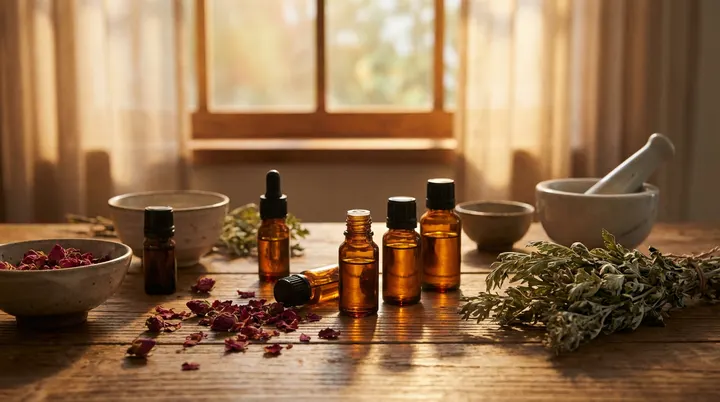
A comprehensive review published in the *Chinese Journal of Experimental Traditional Medical Formulae* reveals the unique charm of TCM aromatherapy in alleviating dysmenorrhea. Aromatic TCM essential oils—the soulful substances extracted from familiar herbs like Angelica (Dang Gui), Chuanxiong, Mugwort (Ai Ye), and Cyperus (Xiang Fu)—are actually nature's highly sophisticated "dual pacifiers for emotion and body."
When these warm, dispersing essential oil molecules penetrate the body through smell or skin, they do not adopt a "forceful suppression" approach. Instead, they act like gentle messengers. On one hand, they regulate the body's levels of prostaglandins and oxytocin, calming the excessive spasms of the uterine muscles. On the other hand, they quietly slip into the nervous system, prompting the body to secrete endorphins that induce a sense of well-being.
Interestingly, dysmenorrhea is often accompanied by anxiety and low mood. And what aromatic molecules excel at most is precisely regulating Qi and relieving depression. They can gently iron out the wrinkles of the nerves while easing physiological cramps. This is not just pain relief; it is an "unbinding" that tunes both body and mind from the inside out.
Of course, we must remain rational. If the pain is caused by organic lesions (such as endometriosis in secondary dysmenorrhea), no essential oil can replace formal medical intervention. Aromatherapy should never be an excuse to avoid hospital check-ups.
But after ruling out organic diseases, for those long and grueling days, aromatic TCM essential oils offer us a wonderfully beautiful alternative. They remind us that in the face of our body's protests, we don't have to be so tense. We can use a wisp of warm fragrance to give ourselves a legitimate, complete reason to relax.

Next time dysmenorrhea arrives as scheduled, besides applying a warm compress and resting, try using a few drops of blended TCM essential oil to slowly massage your lower abdomen in circles. Feel that warmth and fragrance gradually seep in, and tell the body weathering the storm: It's okay, you can slowly let go now.
——
References & Literature
The core mechanisms discussed in this article are derived from: Du Qing, Ye Mingfang, Guan Yongmei, et al. *Research Progress on Dysmenorrhea of Essential Oils of Traditional Chinese Medicine* [J]. Chinese Journal of Experimental Traditional Medical Formulae, 2022, 28(6): 254-261. (For specific pages and citations, please refer to the official publication).
Reference PDF for study; cite the published version.
*Note: This article is for science communication purposes, aiming to share cutting-edge research perspectives on TCM aromatherapy. It does not constitute clinical medical advice. If you experience severe or prolonged unexplained dysmenorrhea, please be sure to consult a gynecology department at a formal medical institution.*