
cultural
Savoring Incense and Enlightenment: The Nearly Lost Aesthetics of Traditional Chinese Life
Agarwood, Sandalwood, Ambergris, and Musk are not only nature's supreme gifts but also the soulmates of ancient literati. Explore the Chinese incense aesthetics.

In the vast sea of classical Chinese culture, there is an art form that does not appeal to visual splendor, nor does it rely on auditory shock, but through the most instinctive breathing, reaches the bottom of human consciousness—this is the Way of Incense (Xiangdao). However, with the passage of time and the impact of Western culture, this noble and elegant pursuit, once regarded by the ancients as a means to cultivate morality and calm the mind, is now nearly lost, causing people to sigh with regret.
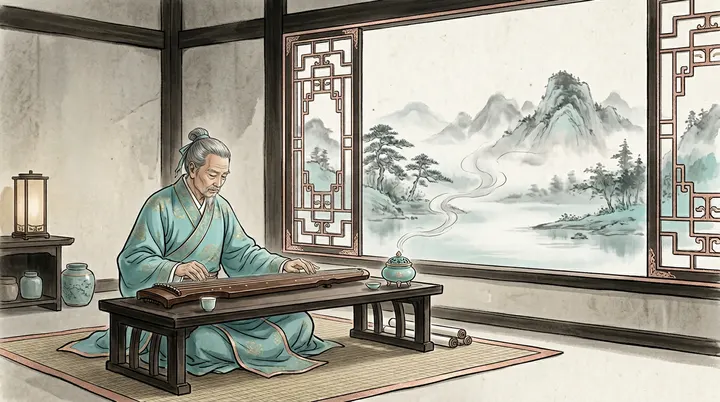
From Temples to Studies: The Peak and Decline of the Way of Incense
When mentioning "incense," what comes to modern minds is mostly the lingering smoke in temples. But in Chinese history, the connotation of the Way of Incense is far more profound.
Before the Han Dynasty, the use of incense was mostly for bathing and rituals; in the Han, Wei, and Six Dynasties, exquisite Boshan burners made incense culture widely popular; during the Sui and Tang Dynasties, the integration of Eastern and Western civilizations greatly enriched the methods of incense use. By the Song and Yuan Dynasties, incense tasting ushered in its golden age, alongside tea tasting, flower arranging, and hanging paintings as the "four leisurely activities" of the upper class. During the Ming and Qing Dynasties, incense study deeply combined with Neo-Confucianism and Buddhism, transforming into "sitting with incense" and "studying with incense," becoming an indispensable elegant display in the scholar's study. Unfortunately, the decline of national power in modern times caused the Way of Incense to gloomily exit the stage. To retain the fragments of this ancient cultural essence, we must restart "from recognizing incense."
Agarwood, Sandalwood, Ambergris, and Musk: Nature's Supreme Gifts
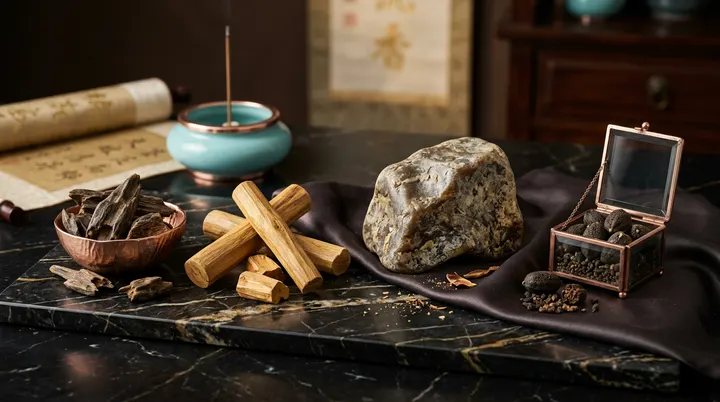
In the vast world of spices, the ancients summarized four famous incenses: "Agarwood, Sandalwood, Ambergris, and Musk." Among these, agarwood is revered as the foremost.
Agarwood is not an ordinary wood, but the resin secreted by the agarwood tree to heal itself after enduring trauma such as lightning strikes and insect bites over a long period, crystallizing in specific climates and environments. The ancients classified agarwood with extreme detail: that formed on the bark is called Qinggui incense, on the main trunk is Zhan incense, and near the roots is Huangshu incense. This treasure, having absorbed the essence of heaven and earth, not only possesses an indescribable fragrance but is also an excellent medicine in TCM. Compendium of Materia Medica records that agarwood can clear meridians, dispel wind-water toxins, and treat restlessness. This is why eminent monks must burn incense during meditation to gather their spirit and enter Samadhi.
Entrusting This Stick of Smoke: The Silent Shaping of Literati Character
"Though the Boshan burner is cold, the incense remains." There is an inextricably linked, almost fateful bond between Chinese literati and incense. It is no exaggeration to say that it was the ever-present fragrance that catalyzed China's unique cultural patterns and literary works.
Starting around the Wei and Jin Dynasties, "incense," this elegant companion, officially entered the lives of literati. By the Tang and Song Dynasties, this infatuation reached an unparalleled level: reading with incense as a friend, spending time alone with incense as a companion; tuning the lute required a stick of clear incense to guide its rhythm; tasting tea and discussing the Dao, how could there be a gathering without incense? Su Dongpo enlightened in "Burning Incense with Huang Luzhi" that "a stick of smoke dissipates, the fire turns cold, half a lifetime passes, the body ages, but the heart is at leisure"; Chen Qufei wrote the open-mindedness of "worldly affairs have past and present, but the nature of incense remains unchanged"; Li Qingzhao poured out eternal sorrow through "Ruinao melting in the golden beast."
Tu Long of the Ming Dynasty profoundly summarized the wonderful uses of incense: reading at night to ward off sleep, waking from a nap to clear the mind, howling at the moon to express one's feelings. The fragrance is like a silent spring rain, silently nourishing and fumigating the souls of literati through thousands of years.
Regaining the Lost Elegance
The true Way of Incense, like an invisible elf, can reach the bottom of body and mind straight from the nose, awakening the most authentic life experience; it is also like open arms, crossing language barriers, allowing the soul to gallop freely in the fragrance.
Studying Chinese culture without ignoring incense is destined to be incomplete. When we feel lost and exhausted in this fast-paced torrent, perhaps we should reignite that long-silent pot of incense. In this rising blue smoke, let us touch that elegant Eastern philosophy and awaken the uncultivated field in our own nature.