
cultural
The Symphony of Scent: The Art of Blending in TCM Essential Oils
Discovering how the ancient Chinese medical principle of Sovereign, Minister, Assistant, and Courier is applied in modern essential oil blending.

Chinese medicine is a luminous part of East Asian civilization. Turn from bitter decoctions to fragrant oils, and a surprise appears: compound oil blending echoes the sovereign–minister–assistant–courier logic of classical formulas.
That is “same root for drug and fragrance”—ancient pattern in modern bottles.
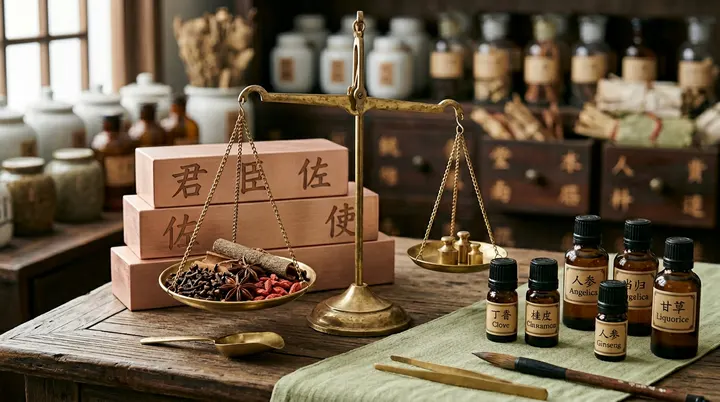
Nature of medicinals and oils
TCM corrects yin–yang imbalance and restores organ harmony; herbs carry four qi, seven flavors, and channel tropisms. Essential oils inherit similar bias—not neutral chemistry only.
Pungent moves and frees: saposhnikovia, angelica dahurica, tang-kuei notes often address windy cold and stagnant complexion. Bitter drains damp and fire: coptis, skullcap serve heat-type acne. Channel and up/down: light herbs such as mint and chrysanthemum “float” to the head and eyes; sedating, astringent notes like coptis, sandalwood, or frankincense “sink” inward. Oils move as if guided along conceptual meridian paths.
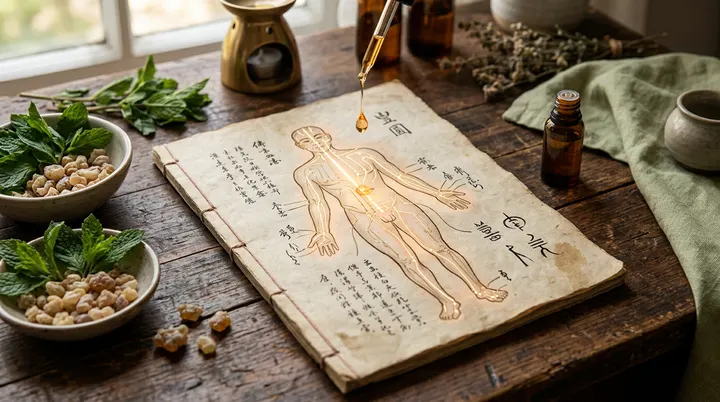
Sovereign, minister, assistant, courier
A classical prescription is not a random pile; neither is a serious compound oil. Blending changes synergy—potentiation, buffering, harmonizing.
In a skin-care massage oil, frankincense, patchouli, neroli, rose might sit in clear roles: sovereign at higher proportion for the main aim; minister reinforcing it; assistant and courier balancing edge, guiding action, reducing irritancy—like sections in an orchestra.
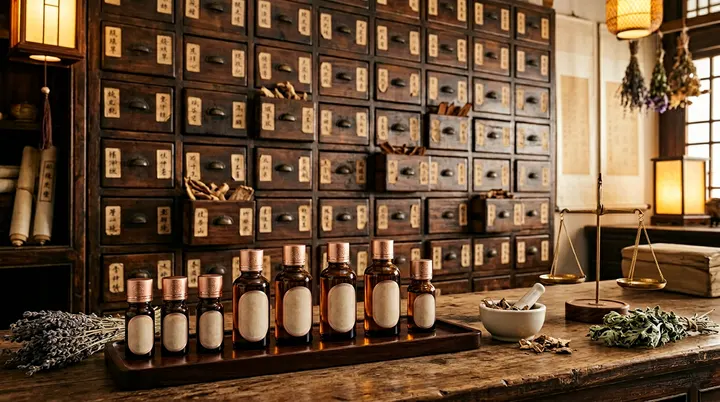
Inside and out: transdermal care
“Treat inside and outside together.” Aromatic TCM loves surface routes—massage, bath, wash, fumigation.
Well-composed oils please the nose, cross skin into circulation, and reach broader pattern—not only local glow. Compared with large-molecule decoctions, small lipophilic molecules can act nimbly. In that mist, one feels the gentler face of Eastern medicine.